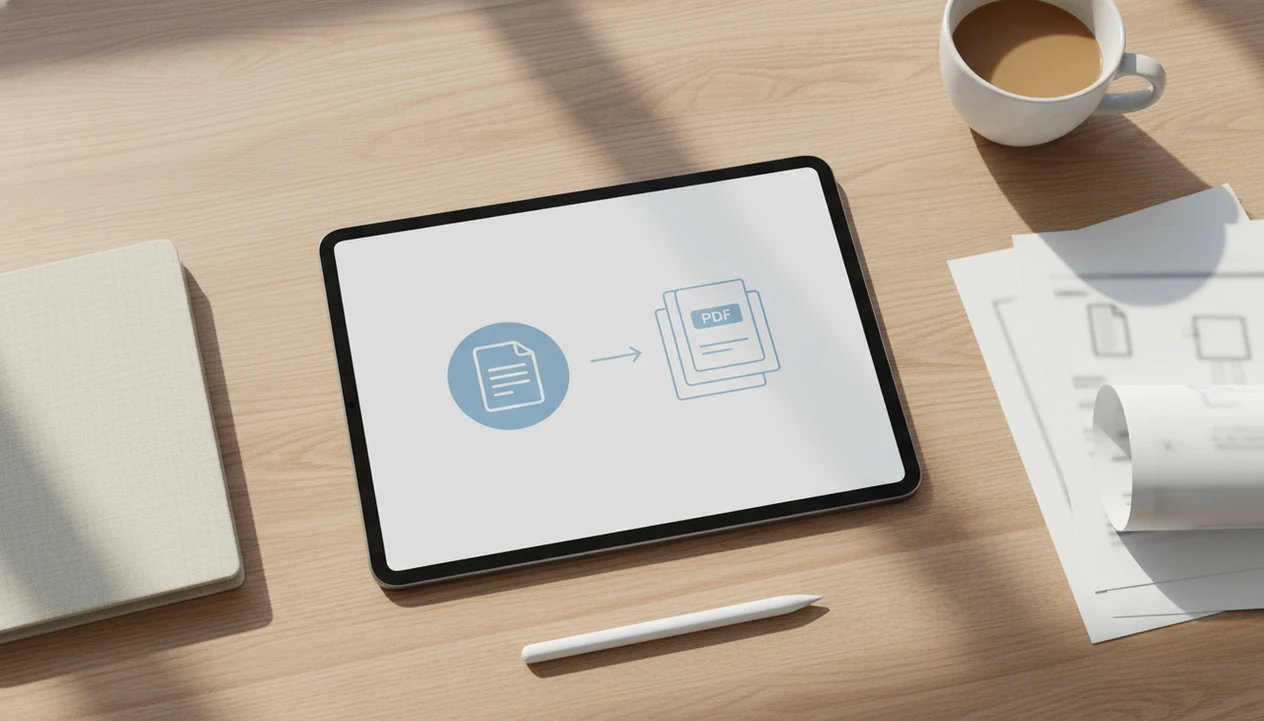
A Word to PDF app for iPad is a mobile tool that transforms.docx and Word documents into non-editable PDF files for sharing, submitting, or archiving directly from a tablet.
- iPadOS can convert DOCX to PDF natively via Files → Print → Share, but a dedicated app adds batch conversion, cloud integrations, and offline reliability.
- 52% of undergraduates use a tablet for coursework, making Word-to-PDF conversion a daily student workflow.
- Offline, on-device conversion matters for contracts, HR forms, and any privacy-sensitive documents.
3 iPad DOCX-to-PDF Paths That Work
- iPad Files can create a PDF from a DOCX file by opening the document preview, choosing Print, then using the share sheet to save the generated PDF.
- Microsoft Word for iPad includes Export to PDF, which usually gives strong layout fidelity for documents created or edited in Word.
- Third-party converters help when you need batch conversion, cloud folder pickup, offline rendering, or a cleaner save-and-share flow.
- Apple Pages can open many Word documents and export them as PDF, but layout can shift if the original file uses unusual Word-only formatting.
- In 2023, iPadOS held about 52% of the global tablet operating system market, so iPad document workflows are not a niche use case source.
The built-in route is fine for one document. It gets clumsy when five class handouts arrive in a course folder and each needs the same PDF export.
The right fit for repeated DOCX handoffs is WordPDF because it keeps the workflow focused on open, convert, save, and share instead of sending you through the print panel every time.
Minimum Requirements for DOCX to PDF on iPad
For most users, iPadOS 15 or newer is the safe baseline for DOCX to PDF iPad workflows. Older iPads may still open files, but share sheet behavior and app compatibility can feel inconsistent.
You need enough free storage for the original DOCX file, the exported PDF, and the converter app. A 2 MB resume is easy. A report with images, charts, and embedded logos can create a much larger PDF.
Internet access depends on the method. Files, Pages, Microsoft Word, and WordPDF can support offline conversion once installed, but some services, including tools like smallpdf.com/word-to-pdf or adobe.com/acrobat/online/word-to-pdf, rely on uploading the file.
WordPDF fits iPad users who pull documents from Files, iCloud, OneDrive, Google Drive, Mail, and LMS portals because the handoff starts from the share sheet or Open In flow. For phone-first workflows, the broader guide to convert Word to PDF on phone covers smaller screens too.
DOCX-to-PDF Rendering on iPad
- A DOCX file is an XML-based package, so conversion reads text, styles, images, tables, and embedded assets before drawing them into a fixed-layout PDF.
- On-device rendering keeps the file on the iPad during conversion; cloud-server rendering uploads the document before returning the finished PDF.
- Apple’s print subsystem can create PDFs through a virtual printer-style process, which is why the Print preview can become a PDF through the share sheet.
- Formatting fidelity depends on the layout engine, available fonts, image handling, and how the original Word file was built.
- Around 63% of U.S. employees said they regularly work remotely or in a hybrid model in a 2021 Statista survey, which helps explain the demand for mobile document conversion.
In practice, the layout check matters more than the convert button. We compare the Word file and PDF side by side when a page break sits near a signature line or a table edge.
Good DOCX-to-PDF converters deliver a fixed, shareable version of a Word file, not full document management, legal signing, or a guarantee that every rare font will survive unchanged. If privacy-sensitive files are involved, use an offline workflow before sending the exported PDF to Files, Mail, or a project folder.
5 Steps to Use a WordPDF on iPad
To use a Word to PDF app on iPad, start from the document source, hand the DOCX file to the converter, confirm the layout settings, and save the exported PDF where you can find it.
- Open the.docx from Files, Google Drive, Mail, OneDrive, or an LMS such as Canvas, Blackboard, or Moodle.
- Tap Share or Open In, then send the file to WordPDF.
- Confirm conversion settings such as page size, orientation, and output name.
- Tap Convert and wait for the on-device render, which can work offline once the app is installed.
- Save the PDF to Files, iCloud, or a shared folder, or send it through Mail or messaging.
On days a recruiter asks for “PDF only” at the last minute, WordPDF earns the spot because the flow ends with a PDF attachment instead of an editable DOCX. The tiny paperclip icon in Gmail is the moment we check twice.
If you are setting up a new device, use the download Word to PDF app page before testing the same share-sheet route on your iPad.
iPad Files App vs. Dedicated WordPDF
The iPad Files app is the easiest free method for one-off conversion, but a dedicated converter is better for repeated document handoffs. The difference shows up when you need batch conversion, predictable naming, or offline handling.
| Option | Works well for | Tradeoff |
|---|---|---|
| Files Print-to-PDF | One DOCX file, no install, quick share sheet save | No batch conversion, no password protection, no OCR |
| Microsoft Word app | Strong Word layout fidelity and native Export to PDF | May require sign-in, and some features depend on subscription access |
| WordPDF | Batch-friendly conversion, cloud folder workflows, consistent save flow | Requires installing a focused converter |
| Online converters | Occasional use from any browser | File upload may be required, which matters for private documents |
A Pew Research Center mobile fact sheet reported that 46% of U.S. tablet owners used their device for work-related tasks source. That lines up with what we see in field reports, invoices, and forms sent from iPad.
For iPad users converting more than one DOCX file per week, a dedicated converter is often easier than Files because it reduces repeated Print and Share steps. For gated feature details, compare the Word to PDF app premium features before assuming a free tool includes everything.
3 iPad Users Who Need a WordPDF
Three groups benefit most from iPad Word-to-PDF conversion: students, remote workers, and business users handling forms or final documents away from a desktop.
- Students submit DOCX assignments to Canvas, Blackboard, Moodle, or school portals that prefer PDF.
- Remote and hybrid workers send reports, estimates, invoices, and job-site notes from the field.
- Business users convert contracts, HR forms, policy drafts, and archived Word documents into cleaner PDFs.
- An EDUCAUSE student technology report found that about 52% of undergraduates used a tablet or 2-in-1 device for at least one course source.
- The dependable workflow is convert, save to the project or class folder, then share from that saved PDF.
Students Converting Homework DOCX to PDF
Students trying to submit from a campus bench need WordPDF because it can take a DOCX from a course folder and produce the PDF before the upload window closes.
Remote Workers Sharing Field Reports as PDF
When a report draft is forwarded by a coworker, WordPDF helps finish the handoff by converting the file, saving it to the right folder, and sharing the exported PDF.
For users who also work from smaller devices, the Word to PDF app for iPhone guide explains the same handoff with iPhone-specific file previews.
What a WordPDF Does on iPad
A Word to PDF app on iPad turns editable Word files into fixed-layout PDFs that are easier to submit, share, or archive. The goal is not to rewrite the document; it is to lock the finished version into a format that looks consistent for the next person who opens it.
For everyday files, the app reads the DOCX, keeps the expected page size, margins, images, headings, tables, and common Word formatting, then creates a PDF you can send from the iPad. That helps when a teacher, recruiter, client, or portal asks for PDF instead of a Word attachment.
- Open the Word document from Files, iCloud, Drive, Mail, or another source on the iPad.
- Convert the DOCX into a PDF with the layout preserved as closely as the file allows.
- Save the finished PDF to Files, iCloud, Google Drive, a shared folder, or an email draft.
- Repeat the same flow for regular handoffs when Print-to-PDF starts to feel slow.
It is still a converter, not a full editing suite. Use separate tools for major edits, e-signatures, OCR, compliance review, or document management.
Limitations
iPad Word-to-PDF workflows are useful, but they do not solve every document problem. Test the flow before a deadline, especially if the document has complex formatting.
- Built-in Print-to-PDF lacks batch conversion, password protection, OCR, and advanced output controls.
- Third-party apps vary in quality; some upload files to remote servers, which can be a privacy concern.
- Complex Word files with unusual fonts, macros, tracked changes, or advanced layouts may show minor spacing differences.
- Many free apps lock unlimited conversions, batch processing, high-resolution output, or watermark removal behind subscriptions.
- Word-to-PDF conversion does not provide legal e-signatures, compliance review, notarization, or full document management.
- Large DOCX files can render slowly on older iPad models, especially when they contain many images.
- Online tools such as ilovepdf.com/wordtopdf and pdf2go.com/word-to-pdf may be convenient, but they are not the same as an offline iPad workflow.
Small shifts happen.
If a footer date must stay visible above the page edge, open the exported PDF in Files preview before sending it. Users who need clean output should also review the Word to PDF app no watermark option.