Rename and share converted PDF files cleanly
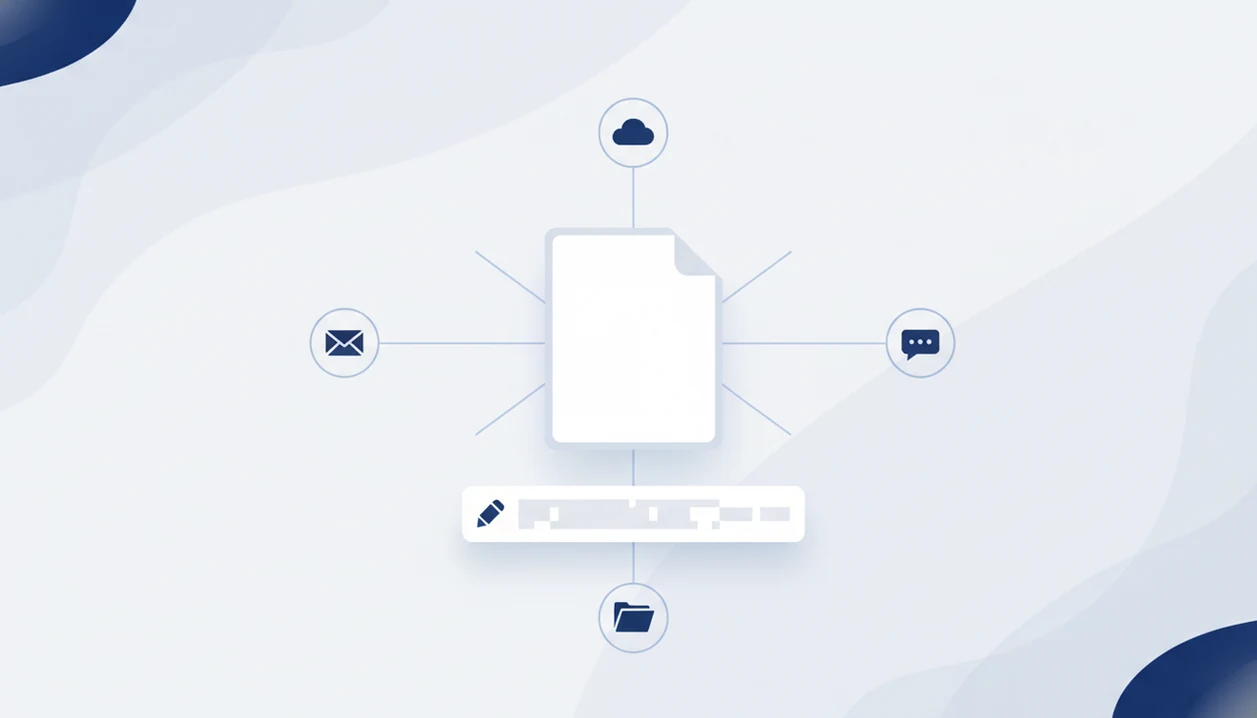
To rename and share converted PDF, use a short descriptive filename, check the file after conversion, then send the actual PDF through a reliable share option. A practical filename pattern is `DocumentTypeProjectOrRecipientYYYY-MM-DD.pdf`.
A mobile document converter can export DOCX or Word files as PDFs on iPhone or Android, but the filename, preview, and share destination still need a final check.
- Rename the converted PDF before sending it so recipients can identify the final document without opening it.
- Use clear words, dates, and safe separators such as hyphens or underscores instead of vague names like `Document1.pdf`.
- Preview the PDF on your phone before sharing to confirm that layout, tables, images, and margins survived conversion.
Clean PDF filenames after Word-to-PDF conversion
A clean converted PDF filename identifies the document type, recipient or project, version, and date when those details help the next person understand the file.
Use names like `InvoiceAcme2026-05-01.pdf`, `ResumeJordan-Lee.pdf`, or `ProposalNorthstarv22026-05-01.pdf`. Those names work better than `final.pdf` because they explain the file before anyone opens it. Descriptive filenames also help in email search, cloud storage, messaging threads, and printer queues.
The tiny paperclip attachment icon in Gmail does not give much room. A clear filename makes that small preview useful.
For shared work, a descriptive PDF filename is often easier to recover than a vague one because the document type and recipient are visible in the file list.
Mobile file behavior after Word-to-PDF conversion
The conversion step creates a new PDF file; it does not erase or replace the original DOCX file.
That matters on phones because several places may show the filename. The converter app may show it first. Then the Files app, Android Downloads folder, email client, cloud drive, printer app, or upload portal may display the same name. If one of those systems shortens the view, the start of the filename becomes especially important.
Simple characters and moderate length reduce trouble during sync, attachment, and cross-platform display. Letters, numbers, hyphens, and underscores behave predictably across most mobile workflows. Adobe Acrobat online, Smallpdf, and mobile converter apps create a separate exported PDF that should be checked before sending.
Good word to pdf converter app that turns docx and word documents into shareable pdf files on iphone and android deliver a final PDF for sending, not a substitute for careful naming, privacy review, or layout checking.
How converted PDF naming and sharing works
Converted PDF naming works because the export creates a separate PDF file with its own filename, while the original DOCX remains behind. Sharing works only when the attachment, upload, cloud link, or print job points to that exported PDF instead of the editable Word file.
That filename then travels with the PDF through ordinary handoff points: email attachments, storage folders, upload portals, messaging apps, and printer queues. Each system may show only part of the name, especially on a phone, so the beginning should carry the most useful words, such as the document type, recipient, project, or date. The file extension is also part of the signal: `.pdf` tells the recipient or portal that the final exported file was selected. A clear name helps people identify the document before opening it, but it is not a security control. It does not encrypt the file, hide the contents, prevent forwarding, or replace a password-protection step when the document is sensitive.
Requirements before you rename and share a converted PDF
Before renaming, make sure the final file and destination are both clear.
- You need a converted PDF file made from a DOCX or Word document.
- You need a PDF viewer or preview screen so you can inspect the exported PDF.
- You need to know the destination, such as an email thread, upload portal, messaging app, cloud folder, or printer app.
- You need any naming rule required by a school, client, employer, court, portal, or print service.
- You need to remove sensitive details that should not appear in the filename.
A recruiter asking for “PDF only” at the last minute is not the time to invent a naming system. If the larger sequence is unclear, the Word to PDF workflow after conversion gives the surrounding steps.
Step 1: Choose a clear PDF filename pattern
Use one predictable filename pattern for each type of converted PDF. Consistency reduces the time spent looking for the right file later.
- Choose a pattern such as `TypeNameDate.pdf`, `ClientProjectVersionDate.pdf`, or `FormLastName_Date.pdf`.
- Add `v1`, `v2`, or `final` only when versions matter to the recipient.
- Put the most useful words near the front, especially on phone screens.
- Avoid names like `new.pdf`, `file.pdf`, `scan.pdf`, and `Document1.pdf`.
- Keep the same pattern across similar files.
A proposal logo may look sharp in preview, but the file can still be hard to identify if it is named `upload.pdf`. Name the PDF for the person who must find it next.
Step 2: Remove risky details from the converted PDF name
A privacy-aware PDF filename avoids exposing sensitive details before the file is even opened.
Do not put full personal IDs, medical numbers, private case numbers, birthdates, or confidential internal labels in the filename. Filenames can appear in email previews, cloud links, downloads, printer queues, and message threads. That visibility is easy to forget when the share sheet is open over a document preview.
Use neutral names for sensitive files. `ApplicationForm2026-05-01.pdf` is safer than a name that includes a birthdate or private account number. For documents that need stronger protection, naming is only one part of the job. The next step may be to password protect PDF after Word conversion.
A safe filename is not encryption. It also does not control who can forward the PDF.
Step 3: Use mobile-safe characters for converted PDF filenames
Mobile-safe PDF filenames use letters, numbers, hyphens, and underscores because those characters travel well across iPhone, Android, email, and cloud storage.
Avoid slashes, colons, quotation marks, question marks, emoji, and unusual symbols. They may look fine in one app but display badly or fail in another. Microsoft's Windows file-naming rules reserve characters such as <, >, :, ", /, \, |, ?, and *, which is why avoiding those characters is the safer cross-platform habit: https://learn.microsoft.com/en-us/windows/win32/fileio/naming-a-file Keep names under about 50 to 100 characters where practical. Short names are easier to read on small screens and sort more cleanly in the Android Downloads folder.
`Invoice-Acme-2026-05-01.pdf` and `InvoiceAcme2026-05-01.pdf` are both practical. `Invoice: Acme / May ❤️ FINAL??.pdf` is asking for trouble.
Small screens punish clutter.
Step 4: Preview the converted PDF before sharing
Should you preview a converted PDF before sharing it? Yes, open the renamed PDF in a viewer or preview screen before sending, uploading, or printing it.
Check the page count, margins, fonts, images, tables, headers, footers, and page breaks. Complex layouts and unusual images are common places for conversion problems. We usually compare the Word file and PDF side by side when a page break before references must stay intact.
If the layout is wrong, reconvert from the Word file instead of trying to fix the problem with a better filename. A clean name helps people identify the file, but it cannot repair missing fonts or a shifted table. For print-specific checks, use a Word to PDF for printing flow before sending the file to a printer app.
Step 5: Share converted PDF files as the final PDF
When the recipient needs the final document, share the actual PDF attachment or choose “Share as PDF.”
- Open the renamed PDF, not the original DOCX file.
- Choose the PDF attachment or “Share as PDF” option.
- Send it through email, an upload portal, cloud storage, a messaging app, or a printer app.
- Confirm the attached or uploaded file still ends in `.pdf`.
- Keep the Word file separately if the recipient needs to edit or review changes.
A PDF is usually better for final sharing than a Word file because it helps preserve layout, fonts, margins, and print appearance across devices. A screenshot is not the same thing. It is harder to search, often worse for printing, and easier to crop by mistake.
For email workflows, Word to PDF for email attachments covers attachment checks in more detail.
Common PDF naming and sharing mistakes
These mistakes cause avoidable confusion after Word-to-PDF conversion.
- Outdated Word name: The PDF keeps the old DOCX name, even though the content changed.
- Endless final labels: Names like `final`, `final2`, and `really-final` appear without a date or version rule.
- Screenshot sharing: The sender shares an image instead of a searchable PDF.
- Wrong file format: The recipient asked for PDF, but the Word file gets attached instead.
- Unsafe sharing: A sensitive PDF goes through a public link or unsecured channel.
- No attachment check: The upload box contains the old file, not the renamed PDF.
File pickers can hide unsupported documents. That is when a clear `.pdf` filename helps you spot the right file quickly, especially when you need to upload Word to PDF to portal.
Converted PDF sharing checklist for iPhone and Android
Use this checklist before you send, upload, print, or message the converted PDF.
- Confirm the filename follows your chosen pattern.
- Confirm the file extension is `.pdf`.
- Confirm the PDF opens and displays correctly in preview.
- Confirm the recipient, portal, or printer app accepts PDF uploads.
- Confirm the file size is acceptable for email, messaging, or upload.
- Confirm the filename does not expose unnecessary private information.
At an airport gate, laptop-free document sending is unforgiving. Open the PDF once in the iPhone Files preview or Android PDF viewer before you rely on the attachment. If the upload fails because the file is too large, you may need to reduce Word to PDF file size before trying again.
Limitations
Clean naming and careful sharing reduce confusion, but they cannot solve every PDF problem.
- A clean filename does not repair missing fonts, broken images, misaligned tables, or bad page breaks.
- A filename does not encrypt, password-protect, or restrict forwarding of the PDF.
- Some recipients use outdated or limited PDF viewers that display advanced features poorly.
- Email, messaging apps, and upload portals may block large PDFs or impose attachment size limits.
- Cloud links can change access depending on permissions, expiration settings, and account rules.
- Some workflows still need the original Word file for editing and revisions.
- The app cannot control what recipients do with a PDF after they download or forward it.
Annoying, but real.
If the PDF must meet legal, school, court, or employer rules, follow those instructions first. A neat name helps, but the portal’s requirement wins.
FAQ
How do I rename a PDF after converting it?
Open the converted PDF in your file manager, converter app, or cloud storage app, then use the rename option to change the filename before sharing. On Android, check the Downloads folder if you cannot find the exported PDF.
What should I name a converted PDF file?
Use a clear pattern such as `DocumentTypeRecipientOrProjectYYYY-MM-DD.pdf`. Examples include `InvoiceAcme2026-05-01.pdf` and `Resume_Jordan-Lee.pdf`.
Can I rename a PDF before sharing it?
Yes, renaming before sharing is usually the cleaner choice because the recipient, portal, or email thread receives the final filename. After renaming, still preview the PDF before sending it.
Should PDF filenames use spaces?
Spaces often work, but hyphens and underscores are safer across email systems, cloud storage, and upload portals. A name like `ClientProject2026-05-01.pdf` is easier to handle than a long spaced title.
Is a PDF better than a Word document for sharing?
A PDF is usually better for final sharing because it preserves the document appearance more consistently. A Word document is better when the recipient needs to edit or track changes.
Can a PDF filename expose private information?
Yes, PDF filenames can be visible in email previews, cloud folders, downloads, printer queues, and message threads. Avoid IDs, birthdates, medical numbers, and private case details in the filename.
Why did my converted PDF not attach to my message?
Common causes include file size limits, poor connectivity, choosing the wrong share option, or restrictions in the messaging app or upload portal. If needed, reconvert the Word file or send the PDF through a different supported channel.